Start Today to Improve Your Cat or Dog’s Healthy Outlook
Regular preventive care visits for your pet is essential for their wellness and overall health. Here are the top three reasons:
Preventive care catches health issues earlier and helps prevent them from becoming more problematic.
Preventive care gives your pet the vaccines and medicines they need to prevent serious health conditions.
Preventive care gives you the space to ask questions about your pet’s health, development and behavior and prevents unnecessary worry or anxiety.
Your pet needs different preventive care at different stages. Let’s explore wellness for puppies/kittens, adults and seniors.
A Healthy Start to a Long Life: Preventive Care for Puppies & Kittens
Give your kitten or puppy their best start in life with early wellness care. Young pets benefit from:
Prevention of diseases like parvovirus or distemper for dogs
Testing for infectious diseases like FeLV and FIV for cats
Parasite testing and/or prevention, from heartworms to roundworms
Starting the vaccine schedule, like rabies, which is required by law
Microchipping to help find your pet if they become lost
Guidance on nutrition, training, socialization and exercise for puppies and kittens
Instruction on brushing your pet’s teeth
Acclimating your puppy or kitten to the veterinarian’s office
Protection & Prevention for Active Years: Preventive Care for Adult Pets
Your adult dog or cat also needs preventive care. These are some of the important things we cover during each visit:
Physical examination of your pet’s body
Simple blood tests that can catch common diseases before they show symptoms
Examination for and treatment of parasites, such as fleas, ticks, mites or internal parasites
Examination of dental health, which affects overall health
Continuation of needed vaccines, based on the latest guidelines, your pet’s lifestyle, and changing technologies
Conversation around any concerns you have regarding nutrition, behavior changes and more
Noting any changes from previous exams and documenting the state of your pet’s health for future exams
Promoting Health & Comfort in Later Years: Preventive Care for Senior Pets
As your pet ages into their senior years, it’s likely they will develop one or more common health conditions. Preventive care helps manage these years for maximum quality of life. Here’s what to expect:
Visits may become more frequent
Pain management might be of higher concern
Preventing disease and preserving dental health are more important than ever
Recommendations for changes to pet food and home environment
Has it been awhile since your pet has come in for a wellness visit? Now would be a great time to make an appointment for their continued health and happiness. Contact us today.
What You Do Today Will Help You Find a Future Lost Pet
Tragically, lost pets are more common than anyone would like. In an ASPCA study, 15% of owners said they have reported a lost dog or cat before. Taking these four prevention steps increase the odds of being reunited with your pet if they ever become separated from you:
Microchip your pet
Collar your pet
License your pet
Vaccinate your pet
1. Microchip Your Pet
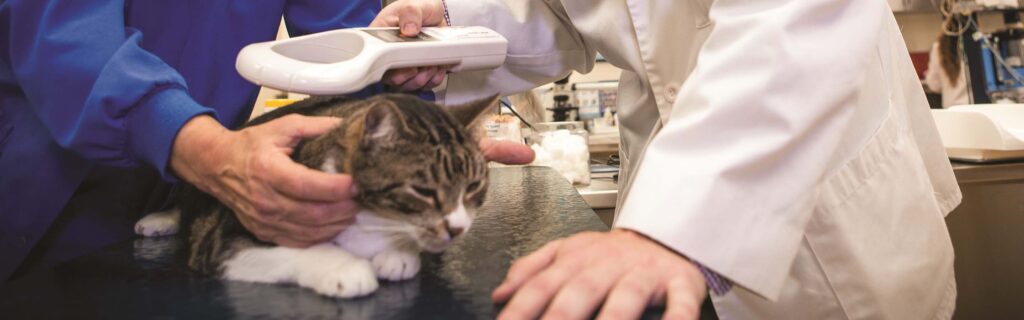
The newest and safest way to ID your pet is with microchipping. A microchip is encased in a tiny glass cylinder and injected under your pet’s skin. When a scanner is passed over the chip, a number comes up. That number is a serial number associated with your registration information. Most veterinarians, shelters and dog wardens have microchip scanners to help reunite pets and their people.
A pet wearing a collar signals to the world that the pet has a home and someone out there loves them. Although microchipping is the most efficient way to have your pet returned to you, it’s not visible like a collar. Also, it can give a pet rescuer something to hold onto, to keep your pet from running away.
Many people purchase custom collars with their pet’s name, their name and phone number embroidered on it.
Along with the collar itself, there are two specific tags that should be attached to the collar, which we explain below.
3. License Your Pet
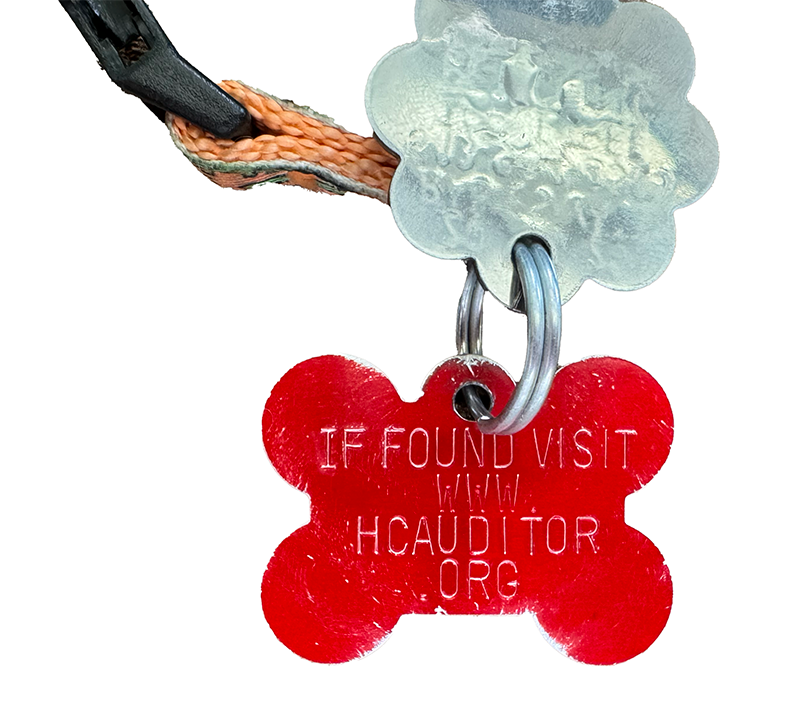
Licensing your pet with the county is the law, and it can help your pet be returned to you if they become lost. Add your pet’s license tag to their collar, and it identifies them with a number. In Hamilton County, people are directed to a website if they find a lost pet. Here’s what the back of that tag looks like:
And here are dog license websites for the counties surrounding Companion Care Animal Hospital:
When a lost pet is vaccinated and wears their rabies tag on their collar, people have more confidence that this pet is safe to help. Ohio counties enforce the law that all dogs, cats and ferrets three months of age and older be vaccinated against rabies.
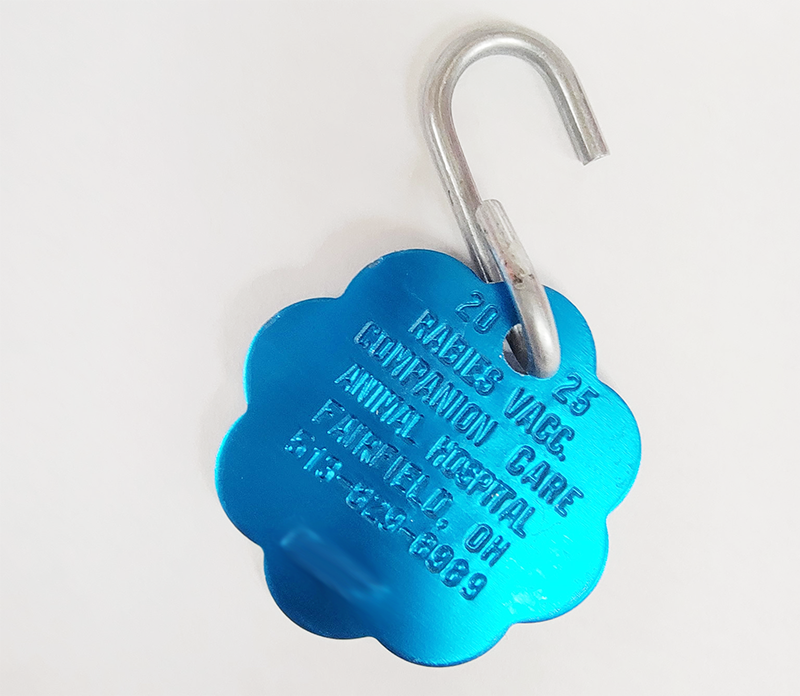
Also, the rabies tag issued by your veterinarian has their identification and phone number imprinted on it. Here’s a sample tag that Companion Care Animal Hospital issues when we vaccinate a pet for rabies:
If all other methods of identifying your pet fail, a Good Samaritan can reach out to your veterinarian to locate you.
We hope your pet never escapes and becomes lost. But it sometimes happens. Following the four ways to ID your pet greatly increase the chances of being reunited. You may also want to read “16 Basic Steps to Prevent a Lost Pet.”
Leptospirosis is a Bacterial Disease Increasing in Dogs
The AVMA monitors the spectrum of diseases that affect animals and adjusts its recommendation as the environment changes. In recent years, the organization has recognized increasing leptospirosis cases in dogs and now recommends all dogs receive the lepto vaccination.
Leptospirosis is caused by the Leptospira bacteria, which is found in soil and water. It’s a zoonotic disease, which means it affects people and some animals, including dogs, livestock, rats, deer, opossums and skunks.
Veterinarian Dr. Myers explains how dogs may contract the disease:
“The bacteria is spread in the urine of infected animals. Dogs can contract the disease by coming into contact with infected urine in standing water, streams, lakes or recently contaminated soil. The bacteria can enter the body through the mouth, nose, eyes or a small cut in the skin or paw pad.”
Do We Need to Worry about Lepto in Cincinnati?
In one 14-year study on canine leptospirosis, researchers found that the disease is most common in the Midwest, East, Southwest and certain counties in Appalachia. Suburban areas and deciduous forests were locations with the highest probabilities of leptospirosis cases. The Cincinnati area matches this description, being in the Midwest region with large areas of forested suburbs.
Symptoms of Lepto
The AVMA reports that the symptoms of lepto in dogs start out fairly generalized:
Loss of appetite
Vomiting
Lethargy
Abdominal pain
Diarrhea
Jaundice (yellowing of the skin and mucous membranes)
Dehydration
Drinking or urinating more than usual
Weight loss
Stiffness or muscle pain
However, the disease can progress to life-threatening kidney and/or liver failure. Also, it can spread to humans.
Your dog and family will benefit from being vaccinated against leptospirosis. Contact us, and we’ll be glad to answer your questions and schedule an appointment.
Vaccinate Your Puppy On Time to Prevent this Deadly Infection
Parvovirus can affect dogs of any age, but parvo in puppies is of especial concern. This virus is highly contagious and significantly fatal, especially in younger animals with immature immune systems.
However, with vaccination, parvo in puppies is almost completely preventable. Veterinarians typically give the first shot at six to eight weeks old, and additional vaccinations are given every three weeks, for a total of four vaccinations.
Learning More about Parvo in Puppies
It’s estimated that 900 US dogs each day are diagnosed with parvovirus. The disease attacks the lining of the digestive tract and young immune cells. Symptoms are distressing and painful to the dog:
Lethargy
GI bleeding
Bloody diarrhea
Vomiting
Dehydration
Shock
Sepsis
Puppies are more at-risk from the dangers of this GI virus, because of their small size and weaker immune system. Dehydration happens more rapidly and leads to the more severe symptoms.
Unvaccinated Dogs and Puppies Can Easily Catch Parvo
This virus is spread through contact with fecal matter of an infected dog. Some strains of parvovirus have the ability to live outside an animal for over a year.
Dr. Kathleen Aicher, assistant professor at the Texas A&M School of Veterinary Medicine & Biomedical Sciences, provides details on why parvovirus is highly contagious:
“Parvovirus is very easily transmitted between dogs because it takes very little exposure to cause infection, and dogs who are infected can shed the virus for a few days before they exhibit symptoms, unknowingly exposing other dogs to the virus. The virus is also very resistant to extreme temperatures and cleaning, so it can remain in the environment for a long time, putting dogs at further risk.”
Dangers of Canine Parvovirus– And Expense of Treatment
Once a dog contracts parvovirus, treatment is critical for survival. Shwntel F. Wilson of Westminster University in Salt Lake City writes:
“Mortality rates of canines with untreated parvovirus remain at 90 percent, while aggressively treated parvovirus has a significantly smaller mortality rate window of 5- 20 percent.”
Treatment usually includes hospitalization, which can last two to seven days. Patients require round-the-clock care, so the treatment of parvo in puppies is very costly. Sadly, even with early and aggressive treatment, there is still a significant chance of death.
Save the Puppies from Parvo!
There’s no need for puppies to endure parvovirus and face this tragic end. Vaccination builds your puppy’s immune system to fight off the virus.
Until your puppy has received its full round of parvovirus vaccinations, avoid public exposure to other dogs, like dog parks and kennels.
Cats and Dogs Can’t Get COVID, but Their Vaccines Can Be Just as Life-Saving for Them
In the last year, it’s been tempting to delay pet wellness visits and get off schedule with your cat or dog’s vaccinations. Veterinarians around the country understand that. During Immunization Awareness Month, we are taking the time to remind pet owners of the importance of keeping your pet’s shots up to date.
Preventative Medicine is Safer and Less Expensive
Vaccinations are a critical part of your pet’s health and wellness because they prevent dangerous conditions. Vaccinations are given to stimulate the immune system against infection before exposure to disease ever occurs.
How Vaccinations Protect Your Cat
There are serious diseases for cats that can be prevented entirely with immunization. Side effects are generally mild, especially compared with the importance of prevention.
These are standard vaccinations for cats:
Feline leukemia (FIV)
Feline viral rhinotracheitis
Feline Panleukopenia
Rabies
Feline Calieivirus
In addition, you may also want to consider these vaccinations for your cat:
Chlamydophila
Bordetella
To grow into a healthy cat, kittens should be vaccinated for the first time between 6-8 weeks of age. Second booster doses are generally given at 10-12 weeks, and again at 14-16 weeks. Adult cats who have been fully vaccinated receive boosters every 1-3 years.
How Vaccinations Protect Your Dog
Unvaccinated dogs are typically at even greater risk for contracting disease, because they are more likely to go outside and come in contact with others than an indoor cat.
These are standard vaccinations for dogs:
Canine distemper
Canine parvovirus
Infectious canine hepatitis
Rabies
Canine influenza (dog flu)
Canine Tracheobronchitis (canine cough)
In addition, you may also want to consider these vaccinations for your dog:
Leptospirosis
Lyme disease
Puppies also start a vaccination schedule around 6-8 weeks, and receive boosters at 10-12 weeks and 16-18 weeks. As adult dogs, they receive boosters every 1-3 years, depending on the type of vaccine. It should be noted that the rabies vaccine is required by law every 3 years.
Have questions about your pet’s immunization or want to know if they are up-to-date? Contact us.
August is National Immunization Awareness month, and immunizations are just as important for pets as for people!
Puppy and Kitten Vaccinations
We recommend starting vaccination with puppies and kittens as early as six to eight weeks of age.
These are standard vaccinations for cats:
Feline leukemia (FIV)
Feline viral rhinotracheitis
Feline Panleukopenia
Rabies
Feline Calieivirus
In addition, you may also want to consider these vaccinations for your cat:
Chlamydophila
Bordetella
These are standard vaccinations for dogs:
Canine distemper
Canine parvovirus
Infectious canine hepatitis
Rabies
Canine influenza (dog flu)
Canine Tracheobronchitis (canine cough)
In addition, you may also want to consider these vaccinations for your dog:
Leptospirosis
Lyme disease
Canine coronavirus
Vaccinations for Adult Dogs and Cats
Immunization in pets doesn’t last for life. For dogs, receiving a DAPP booster annually protects against distemper virus, adenovirus type 1 and type 2, canine parainfluenza virus and parvovirus. A rabies vaccination needs a booster after the first year then on a regular schedule after that. A bordetella vaccination is administered every year or six months. Dogs are also recommended to receive a canine influenza vaccine annually.
Cats receive an annual FVRCP booster to prevent rhinotracheitis, calicivirus, and Panleukopenia (distemper). Cats may also be required to receive rabies vaccines every one to three years, as well.
If it’s been awhile since your pet’s last check-up, it’s probably time to ask about vaccine boosters. Let’s keep our cats and dogs healthy!
Vaccinations are a Critical Part of Your Pet’s Health and Wellness
Preventative medicine is always better for your pet (and less expensive, too!). Vaccinations are given to stimulate the immune system against infection before exposure to disease ever occurs.
What to Expect After Your Pet’s Vaccination
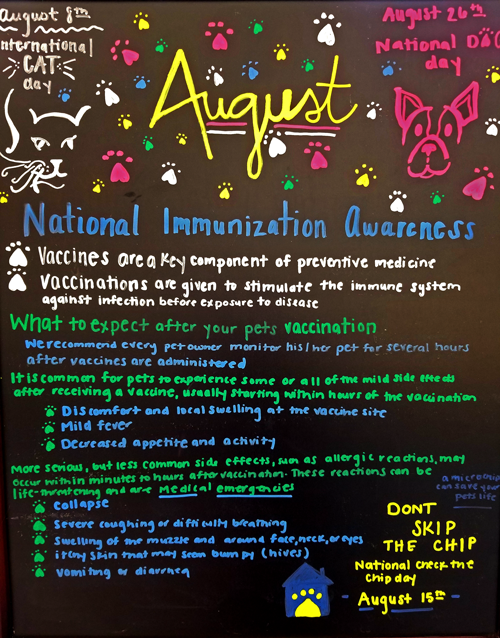
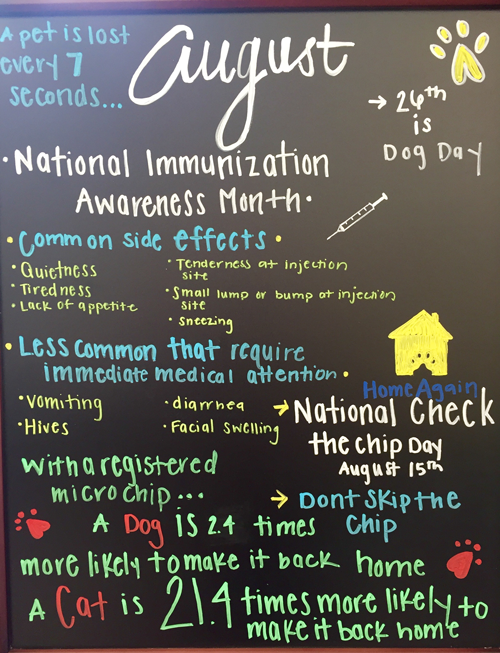
We recommend every pet owner monitor their pet for several hours after vaccines are administered. It is common for pets to experience some or all of the following mild side effects after receiving a vaccine, usually starting within hours of vaccination:
Discomfort and local swelling at the vaccine site
Mild fever
Decreased appetite and inactivity
More Serious, but Less Common Side Effects
Uncommon but serious side effects, such as allergic reactions, may occur within minutes to hours after vaccination. These reactions can be life-threatening and are medical emergencies. Watch for these signs:
Collapse
Severe coughing or difficulty breathing
Swelling of the muzzle and around face, neck or eyes
Itchy skin that may seem bumpy (hives)
Vomiting or diarrhea
If you have any questions about your pet’s health, please give us a call at (513) 829-8989.
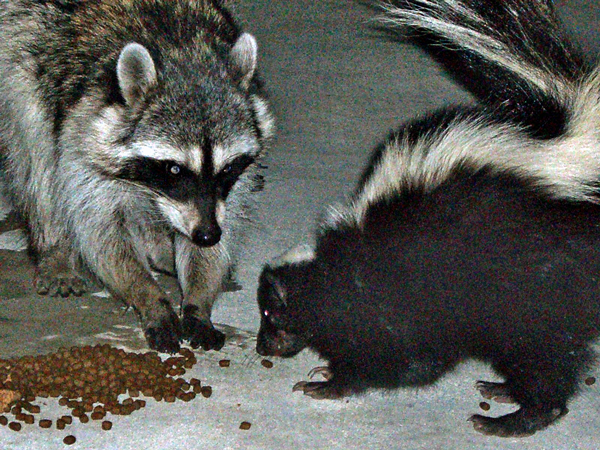
World Rabies Day is September 28. The CDC identifies rabies as the deadliest virus in the world, annually killing 59,000 across the globe. In the US, most instances of rabies are reported from raccoons, bats, skunks, foxes and other wild animals.
Keeping your pets away from wild animals is an important part of preventing rabies. Some of the symptoms of the disease are unexpected. Here’s what the CDC recommends:
If you see an animal acting strangely, report it to animal control or your local health department. Some things to look for are:
General sickness
Problems swallowing
Lots of drool or saliva
An animal that appears more tame than you would expect
An animal that bites at everything
An animal that’s having trouble moving or may even be paralyzed
Sometimes, people may come across a dead animal. Never pick up or touch dead animals. The rabies virus may still be present in the saliva or nervous tissue, especially if they have only been dead for a short time. If you see a dead animal, call animal control to take care of the animal’s body.
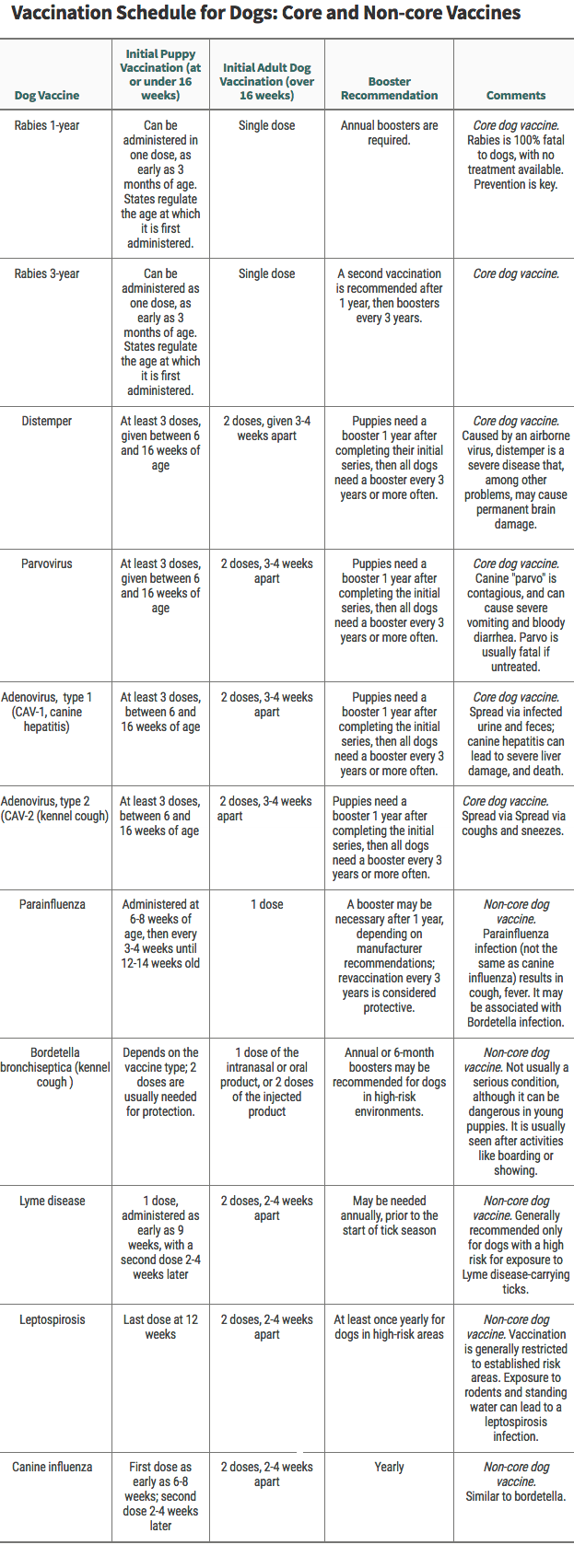
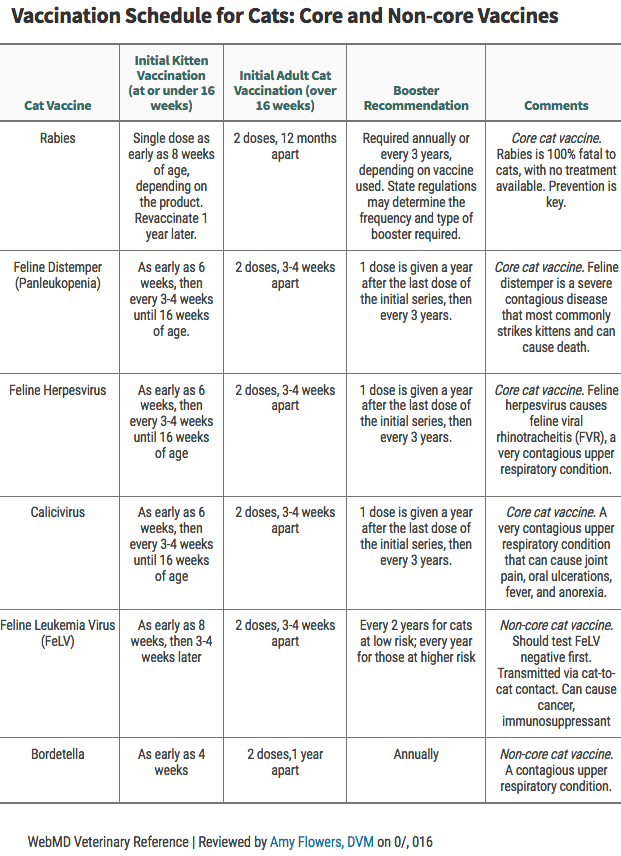
Immunization is just as important for your pet as for humans. Many vaccines can be given to a puppy or kitten as young as six weeks old and will protect against potentially deadly bacteria and viruses found in your pet’s everyday environment.
Take a look at these suggested vaccination schedules presented by WebMD, and please give us a call if you have any questions about your dog or cat’s immunization status.
August is National Immunization Awareness Month. While vaccinating your pet is very important for their overall health, there are side effects. Here’s a list of common immunization side effects for pets, along with less common side effects that require immediate medical attention:
“Pets should be vaccinated to protect them from many highly contagious and deadly diseases. In some cases (rabies, for example), vaccinating your pet can also protect you from disease. If an unvaccinated pet develops one of these diseases, treatment can become very expensive and many of these diseases can be fatal, even if your pet received prompt and appropriate treatment. Rabies vaccination is required by law in many states and counties.
“Not all pets should be vaccinated with all available vaccines. “Core” vaccines are recommended for most pets in a particular area because they protect from diseases most common in that area. “Non-Core” vaccines are reserved for individual pets with unique needs. Your veterinarian will consider your pet’s risk of exposure to a variety of preventable diseases in order to customize a vaccination program for optimal protection throughout your pet’s life. Talk with your veterinarian about your pet’s lifestyle including its expected travel to other geographic locations and/or contact with other animals (such as exposure at kennels, obedience classes, shows, and dog parks) since these factors impact your pet’s risk of exposure to certain diseases. For older pets, make sure your veterinarian is aware of any previous adverse reactions to vaccines.”
Core Vaccines for Cats
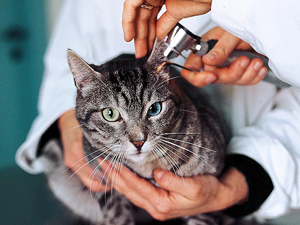
At this time, “core” Vaccines, as recommended by the American Association of Feline Practitioners (AAFP) for all kittens and cats, include:
Feline panleukopenia, FPV or FPL (also called feline infectious enteritis or feline distemper) caused by FPL virus or feline parvovirus (FPLV)
Feline viral rhinotracheitis, FVR caused by FVR virus, also known as herpes virus type 1, FHV-1
Feline caliciviral disease caused by various strains of Feline caliciviruses, FCV
Rabies caused by Rabies virus
Core Vaccines for Dogs
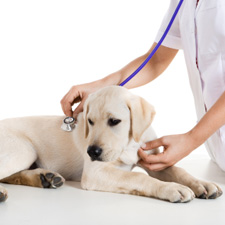
These vaccines are recommended for all puppies and dogs by the American Animal Hospital Association (AAHA) Canine Vaccine Task Force:
Canine distemper virus
Canine parvovirus
Canine adenovirus-2 (hepatitis)
Rabies virus
Please call us if you have any questions about pet vaccines, or if your pet is experiencing some of the less common side effects.









 Puppy and Kitten Vaccinations
 In addition, you may also want to consider these vaccinations for your dog:
 Preventative medicine is always better for your pet (and less expensive, too!). Vaccinations are given to stimulate the immune system against infection before exposure to disease ever occurs.
 More Serious, but Less Common Side Effects
 World Rabies Day is September 28. The CDC identifies rabies as the deadliest virus in the world, annually killing 59,000 across the globe. In the US, most instances of rabies are reported from raccoons, bats, skunks, foxes and other wild animals.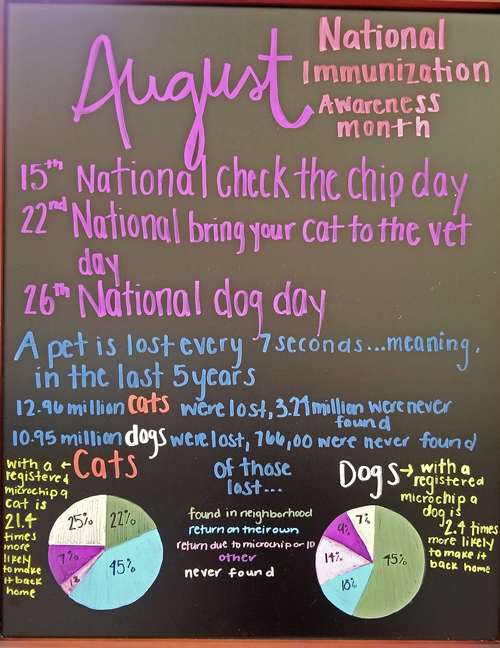
 At this time, “core” Vaccines, as recommended by the American Association of Feline Practitioners (AAFP) for all kittens and cats, include:
 These vaccines are recommended for all puppies and dogs by the American Animal Hospital Association (AAHA) Canine Vaccine Task Force: